ChimpBenchAbout
Open ChimpBench

A chimpanzee society simulation, based on wild chimps.

ChimpBench simulates communities of wild chimpanzees in a 3D rainforest modeled on Kibale, Uganda. Each chimp feeds, rests, travels, grooms, fights and reconciles, patrols, hunts, raises young and ages, through day and night and the seasons.

A personal experiment in using decision models to drive behavior. Each chimp’s choices come from what it senses and how it feels, and are decided by rules or by a small AI model running on your computer. The results are compared with field data from wild chimps.

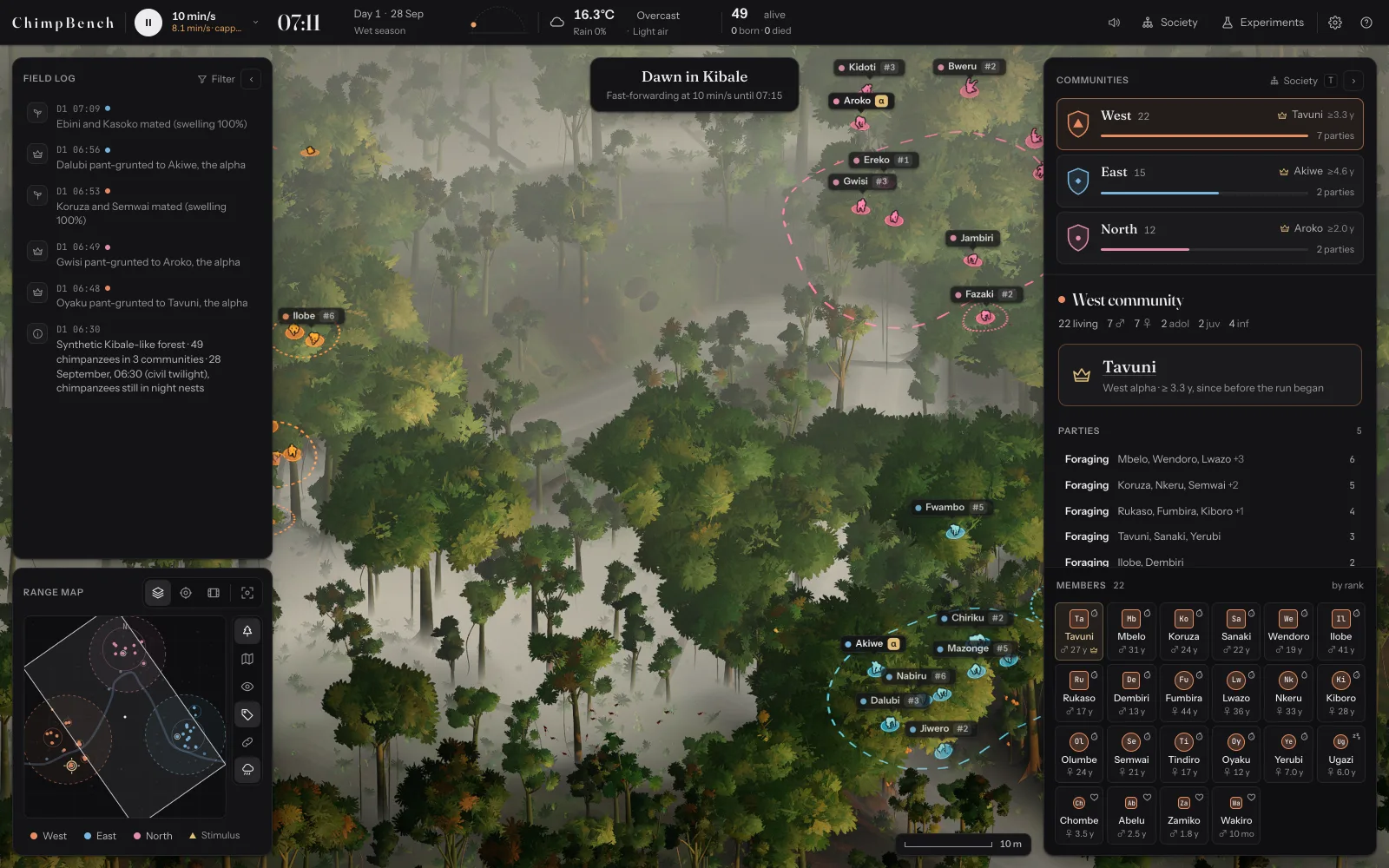
The ChimpBench app at dawn on day one: the field log and range map on the left; the misty forest in the middle, with labelled chimps and dashed community ranges; on the right, the communities with West selected, its alpha Tavuni, its foraging parties and a grid of its members.
Dawn, day one. The field log and range map on the left, the forest in the middle, and the communities on the right, with the selected community's parties and members below. Colors mark the communities: West, East and North.
Jump to a section
  1. Background
  2. Individual chimps
  3. Daily routine
  4. Decisions
  5. Society
  6. Field experiments
  7. Architecture
  8. Chimp data
    1. Fruit calendar
    2. Movement
    3. Patrols and territory
  9. Credits

Background

The forest is modeled on Kibale National Park in western Uganda, home to Ngogo and Kanyawara, two wild chimpanzee communities studied for decades. The individual chimps and their histories are made up. How they behave comes from what field researchers there, and at other sites, have published.

12 km Kanyawara Ngogo equator N
  • Unevenly matched communities

    One community starts with more grown males than its neighbours. That's the kind of edge Ngogo, an unusually large community, has over its neighbors, and it grew its territory after a decade of lethal raids (Mitani, Watts & Amsler 2010).

  • Kibale's trees

    Ngogo and Kanyawara sit only 12 km apart yet grow noticeably different food trees (Potts, Chapman & Lwanga 2009). The simulated forest grows several of the species they recorded, giant figs included.

  • Kibale's weather and light

    Two rainy seasons, afternoon thunderstorms, cool dawns and warm afternoons, and a real equatorial sun and moon.

  • A stream

    The chimps drink from it and cross it only at shallow fords.

Wild behaviours in the simulation

  • Border patrols are silent

    Males walk the edge of their territory in single file, quiet, listening. At Ngogo one set out about every 10 days (Watts & Mitani 2001).

  • They compare numbers before a fight

    Play a stranger's call from a hidden speaker and males move in when their side has the numbers (Wilson, Hauser & Wrangham 2001).

  • Most fights are bluffs

    Hair on end, charging, dragging branches, drumming on roots. It looks scary, and that's the point: it rarely comes to blows.

  • They make up

    Opponents often reconcile soon after a fight, and bystanders comfort the loser (Kutsukake & Castles 2004).

  • Daughters move away

    As teenagers, most females join a neighboring community. Males stay where they were born, for life.

  • A new nest every night

    At dusk every chimp past toddler age bends branches into a new nest high in a tree (on how they pick nest trees: Samson & Hunt 2014).

  • Males hunt together

    Parties with more males hunt red colobus monkeys more often and catch more (Mitani & Watts 1999), then share the meat with allies (2001).

  • They warn others about snakes

    At a snake, chimps call more when nearby group members haven't seen it yet (Crockford et al. 2012).

  • They remember old groupmates

    Apes recognize former groupmates decades later, most of all the ones they got along with (Lewis et al. 2023).

  • A long childhood

    Babies nurse for almost five years (Bray et al. 2017), and a mother has a new one about every five (Wallis 1997).

Individual chimps

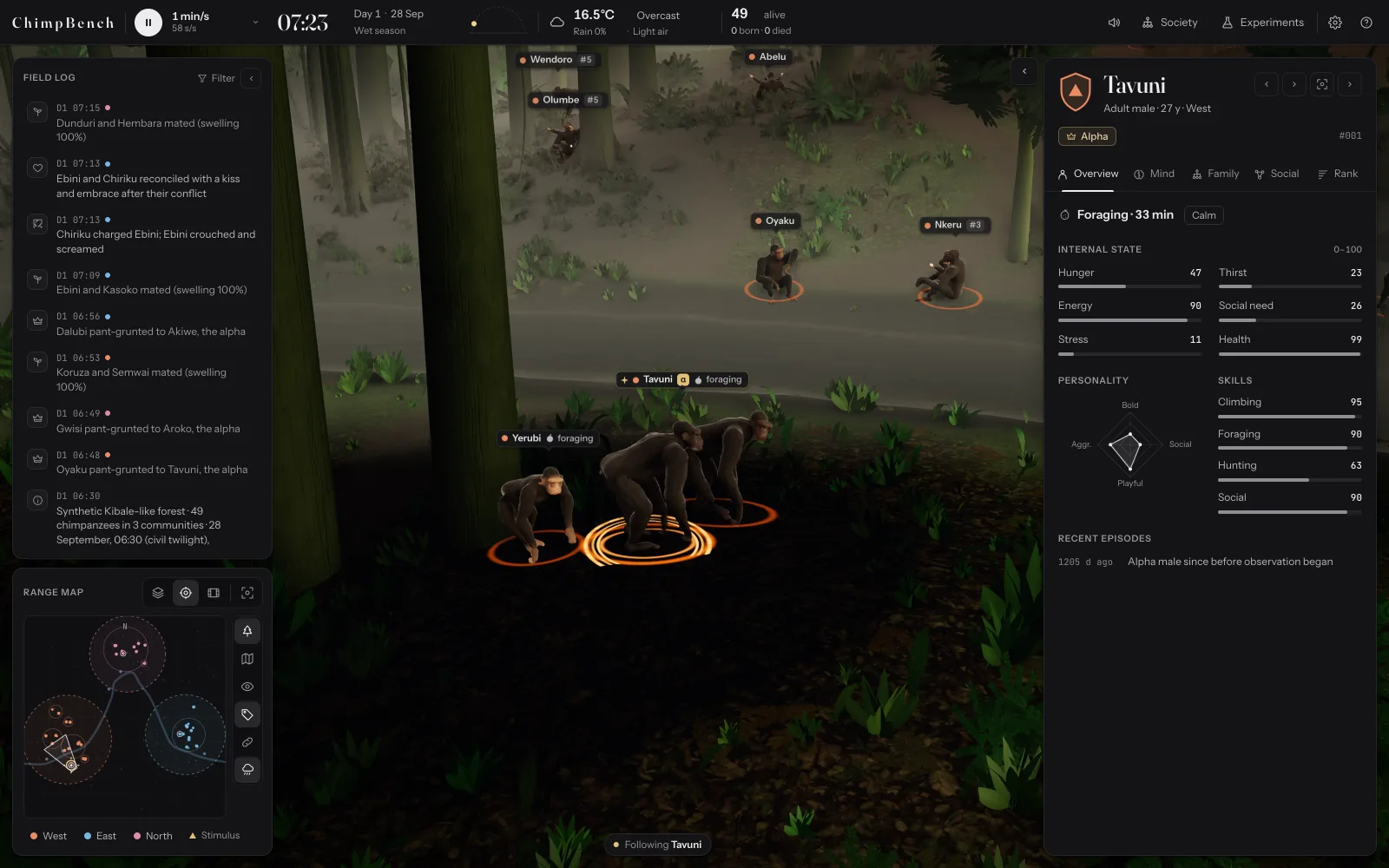
Each chimp is a full individual: a body with needs, a mood, a personality, a rank, a family, friendships, grudges and a memory. The inspector shows all of it. Below is an example card for one chimp, Koruza, from one run.

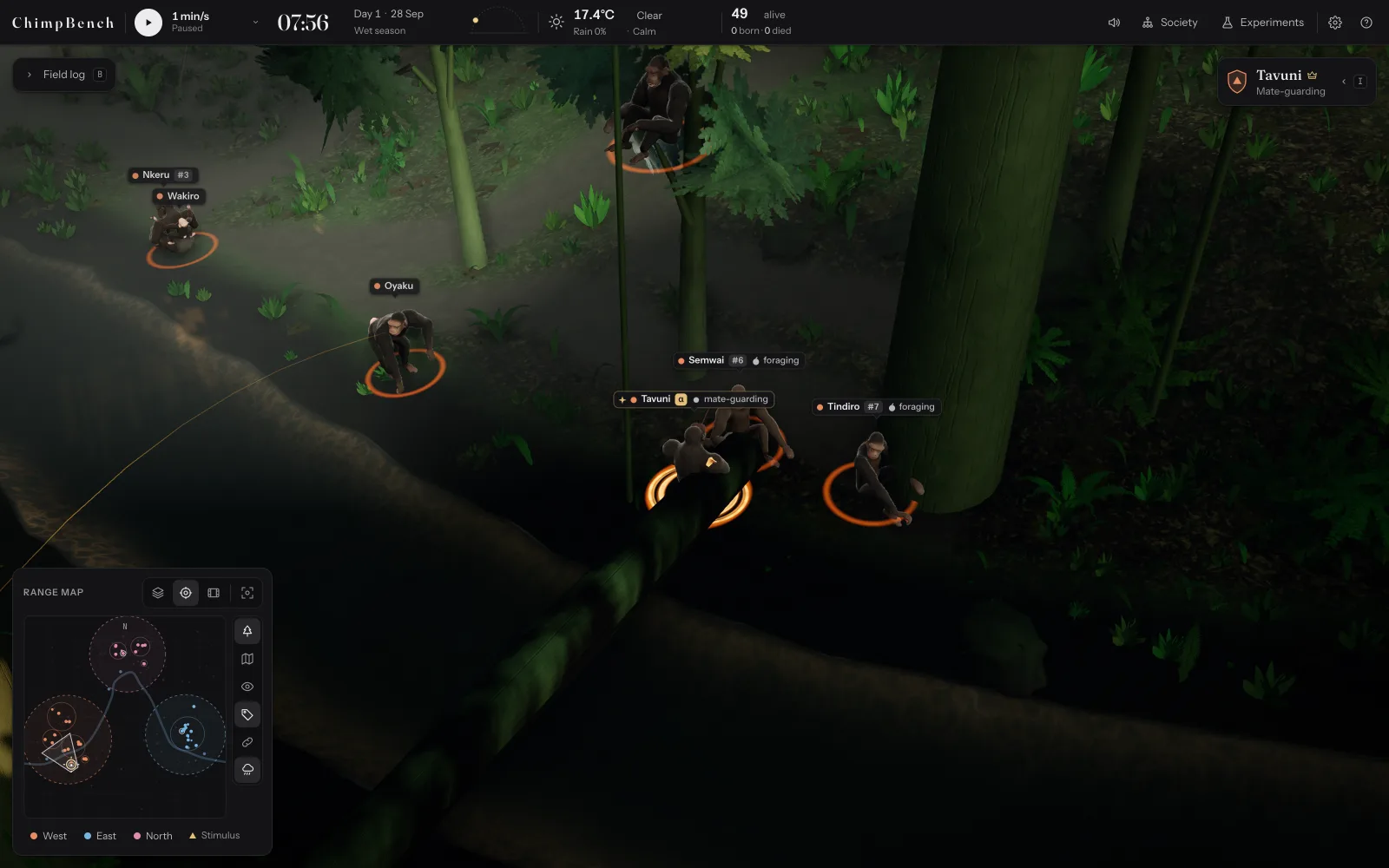
Close view on the forest floor, following Tavuni, the West alpha, as he mate-guards Semwai. Around them Fumbira forages, Kiboro pant-grunts and the young Yerubi and Zamiko play, each labelled and ringed in the West color. The panel on the right shows Tavuni's Overview: one state line, Mate-guarding · 1 min, Calm, then his needs, personality and skills.
Close view. Following Tavuni, West's alpha, as he mate-guards while others forage, play and pant-grunt around him. His Overview opens with one line: what he's doing, and his mood. Press C in the app for this view.
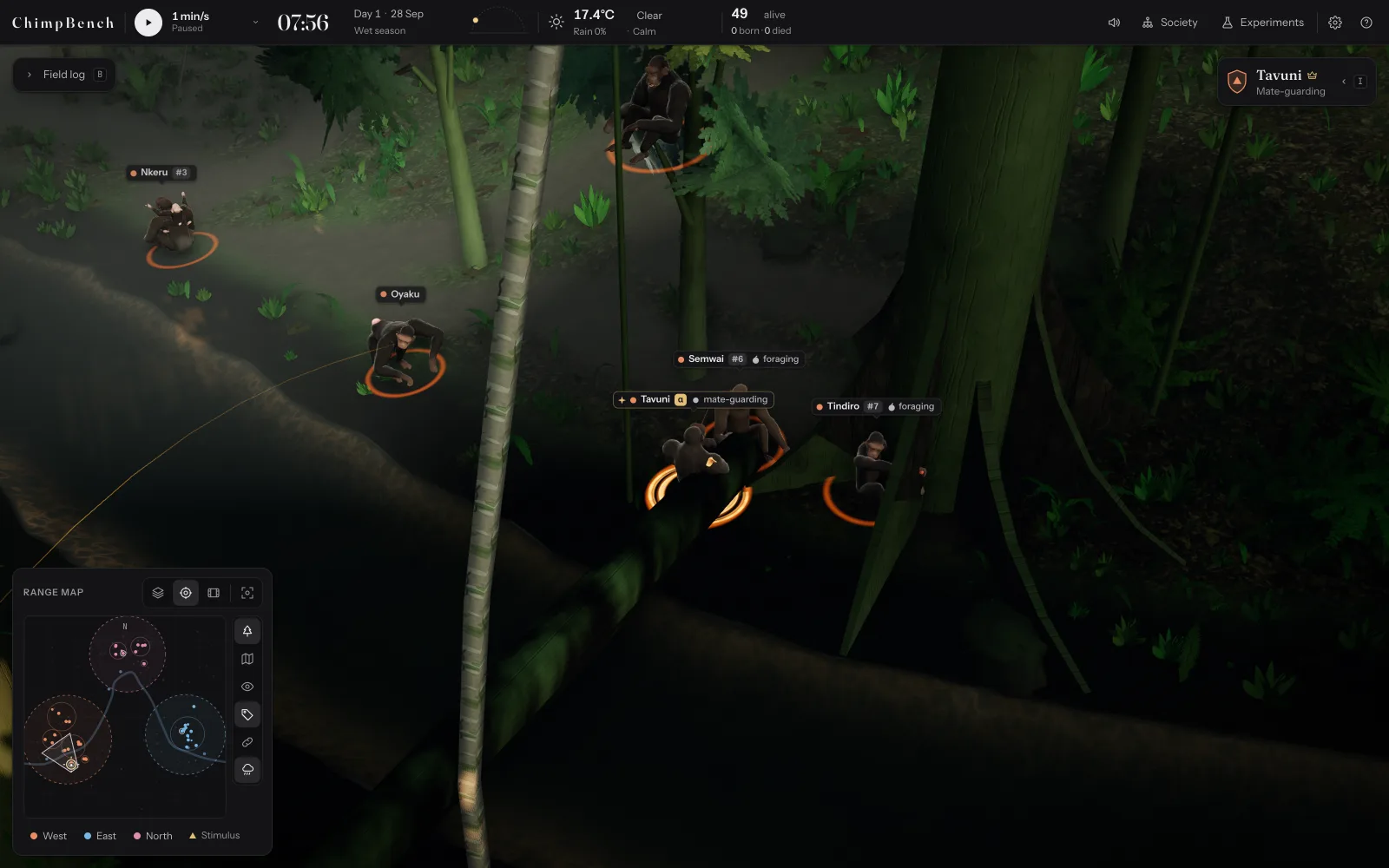
Close view with the keep-clear fade switched off: a tree trunk crosses between the camera and Tavuni's party and hides part of it.
Keep-clear off. The same paused moment with the fade switched off (a debug switch): a trunk hides part of the party.
The same moment with the keep-clear camera on: the trunk in front fades, and the chimps behind it, around Tavuni, are visible.
Keep-clear on. The close camera fades whatever stands between you and the chimps you're following.

Koruza

West communityAdult male, 24Rank 3 of 8 males
Right now: grooming Mbelo

Body

Needs rise and fall all day. Food fixes hunger, grooming fixes loneliness, sleep fixes tiredness.

Hunger
Thirst
Energy
Lonely
Stress
Health

Mood and personality

Mood comes from what's happening. Personality is set at birth and sticks.

calmexcitedplayfulfearfulaggressivedistressed
Bold
Sociable
Aggressive
Playful

Skills

They grow with practice: play builds climbing, feeding builds foraging, hunts build hunting.

Climbing
Foraging
Hunting
Social

Rank

Males climb by winning contests. The one on top is the alpha, the boss of the community.

  1. 1Tavuni
  2. 2Mbelo
  3. 3Koruzayou are here
  4. 4Sanaki
  5. 5+ 4 more

Family

Mom and siblings matter most. Dad is in the records, but no chimp knows who he is.

Fumbira, mom ?dad Koruza Rukaso Oyaku

Friends and rivals

Grooming and backing each other up build bonds. A fight leaves tension that fades over a few weeks, faster if they make up.

  • Mbeloally
  • Rukasobrother
  • Sanakitense, fought yesterday
bondtension

Memory

A diary that summarizes itself. Fresh moments stay detailed, months get condensed, and each year becomes one entry kept for life.

Recent momentsthe latest few
  • Just now: started grooming Mbelo
  • 2 h ago: lost a fight with Sanaki
  • 5 h ago: heard strangers to the east
Monthly summariesthe past year
  • Last month: groomed most with Mbelo; backed by Rukaso 6 times; made up with Sanaki twice
Yearly summarieskept for life
  • Last year: climbed to rank 3; closest friend Mbelo
When a model decides for a chimp, it gets a small slice of this: how the chimp feels, who's around, and a few memory lines about them.

Daily routine

The simulation keeps real equatorial time: sunrise and sunset just before seven, about twelve hours of daylight all year. The timeline shows what most chimps are doing across a typical day.

Calls
  1. Dawn chorus06:24–07:24 · everyone joins in with pant-hoots, their loud rising “hoo-hoo-HOO” that carries far
  2. Dusk chorus18:00–19:00 · one more round before bed
Doing
  1. Asleepuntil about 06:50 · still in last night's nests
  2. Breakfast, mostly fruit06:50–11:30 · feeding at fruit trees and moving between them
  3. Siesta, grooming11:30–14:30 · resting through the heat, grooming friends
  4. More feeding14:30–17:50 · back to the trees
  5. Build a nest, sleepfrom about 17:50 · a fresh nest, then sleep
Patrols
  1. A border patrol may set out08:00–15:30 · every week or two, a group of males heads for the border
Storms
  1. Thunderstorms most likely12:30–19:00 · about two-thirds of the rain falls in the afternoon

Rainy seasons

Kibale gets rain from March to May and again from September to November, with drier spells in between. Fruit follows the rain about six weeks later.

Figs are different: each tree fruits on its own schedule, so some figs are usually ripe when little else is.

15 °Cat dawn
24 °Cafter lunch
Rain per month, mm, as simulatedwet season
  1. 62J
  2. 78F
  3. 150M
  4. 185A
  5. 160M
  6. 78J
  7. 60J
  8. 110A
  9. 155S
  10. 185O
  11. 180N
  12. 95D

About 1,650 mm a year. Every new forest opens at 06:30 on 28 September, in the middle of the rains.

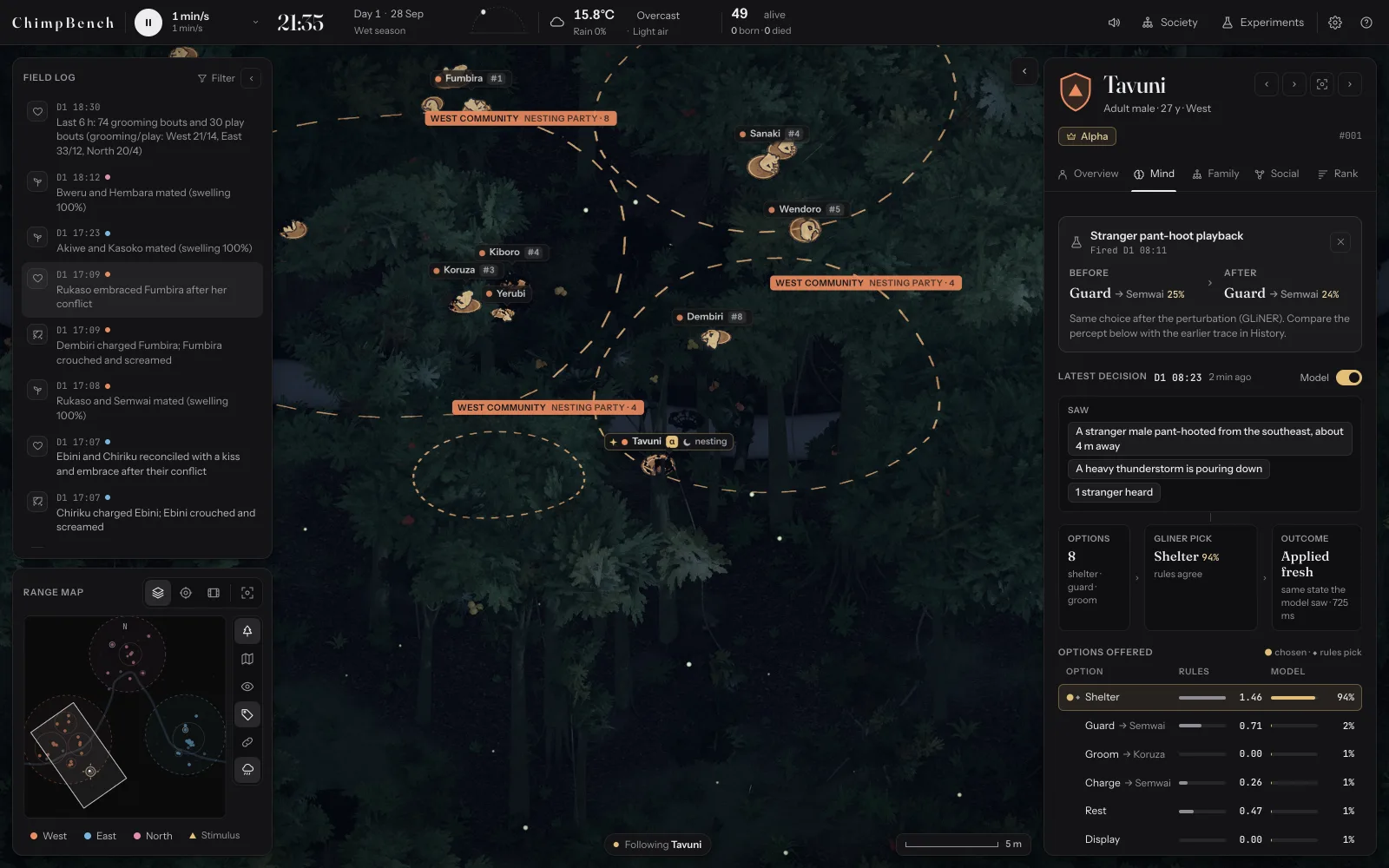
The forest at 21:35 from above: West chimps asleep in their nests in the canopy, grouped into labelled nesting parties inside dashed outlines. The field log on the left lists the evening's events, and the panel on the right shows Tavuni's Mind tab.
Night. The chimps asleep in fresh nests, grouped into nesting parties.
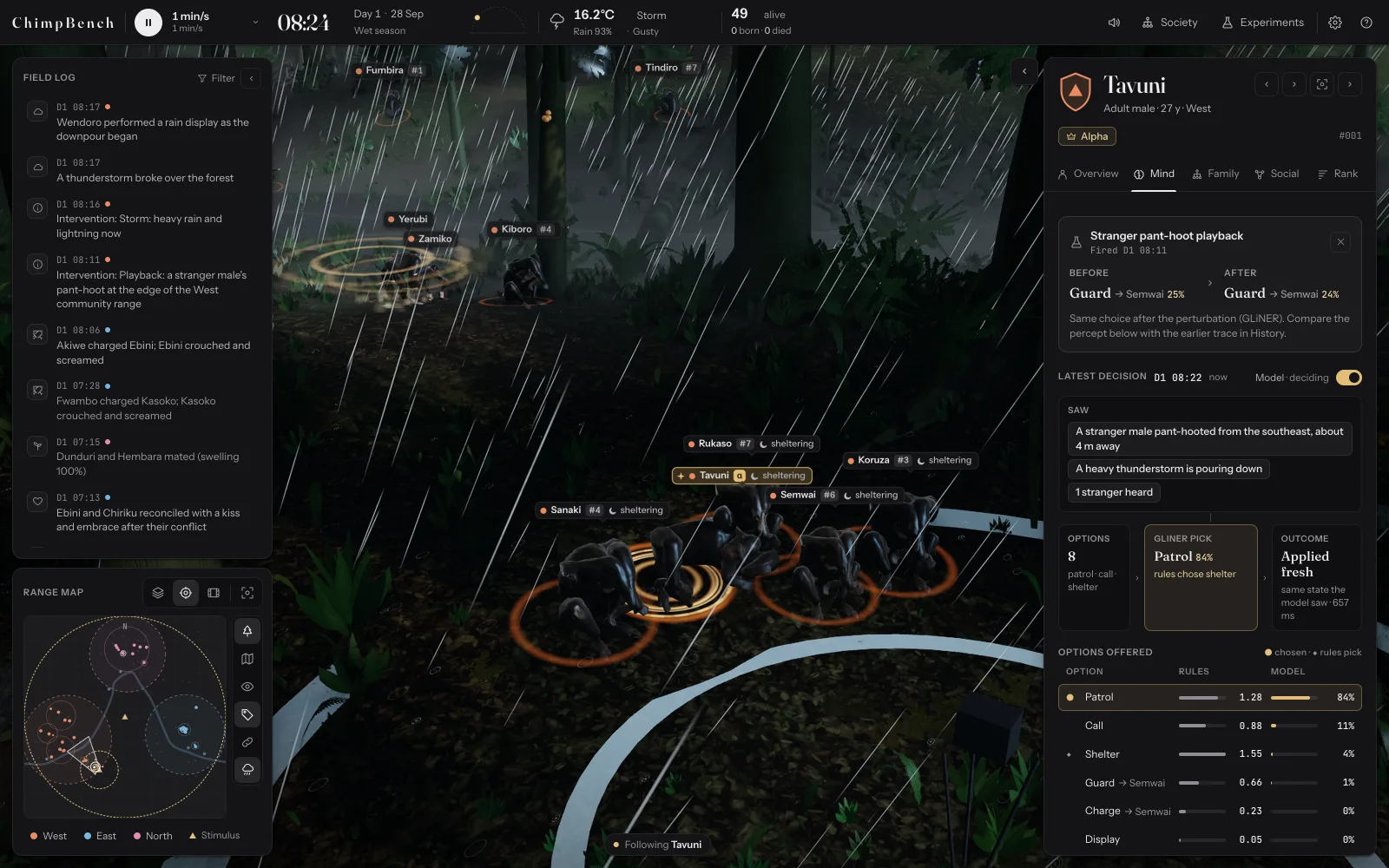
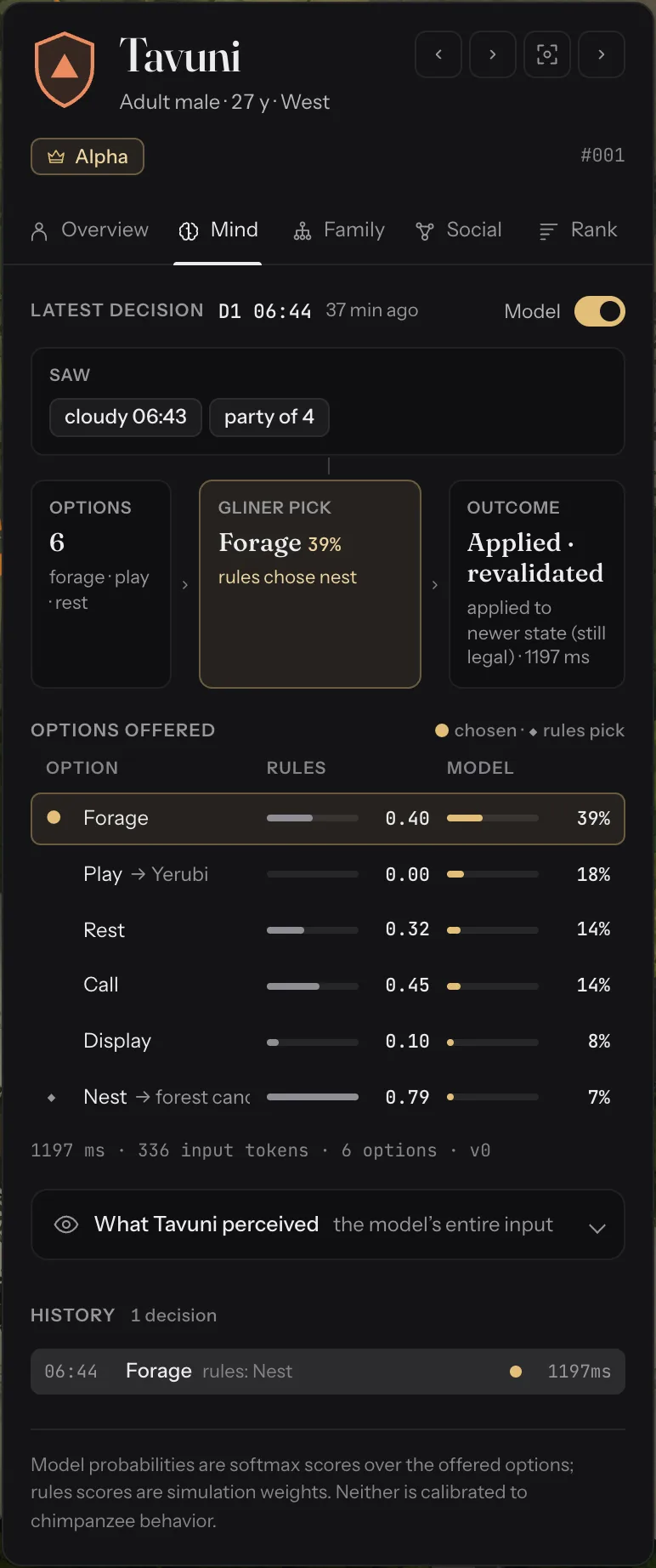
A heavy storm with rain streaks over the forest floor. Sanaki and Rukaso sit hunched, sheltering, beside Tavuni, who is labelled patrolling; the field log reports that Kidoti performed a rain display as the downpour began. The Mind tab on the right shows Tavuni's latest decision: GLiNER picked Patrol, and the rules agreed.
A storm. Most of the party hunches down to wait it out, and Kidoti did a rain display (see the log). Tavuni, still reacting to a stranger's call, patrols.

Decisions

Nothing is scripted. Whenever a chimp finishes what it was doing, or something interrupts it (a charge, a storm, a stranger's call), it stops and makes a fresh decision. This repeats for every chimp, all day.

  1. Sees and hearsonly what's nearby, no peeking at the map
  2. Remembersfriends, fights, fruit trees, water
  3. Lists optionsonly moves that are possible right now
  4. Picks onethe built-in rules or a decision model
  5. Actseats, grooms, charges, naps…
  6. World changesbellies, bonds, ranks, everyone nearby

Every chimp, all daythen back to step 1

…and back to step 1.

  • Rules

    The built-in rules score each option with a simple recipe (hungry plus fruit nearby means go eat) and take the top one. They run every chimp the decision model isn't running.

  • Async default

    The forest keeps moving while the decision model thinks. If an answer comes back late, the rules fill in and the chimp carries on.

  • Lockstep

    The forest pauses at every model decision and waits for the answer, so every pick lands exactly when it was asked.

Outside the app, test runs hand the same chimps to other deciders: trained adapters, the stand-ins that imitate them in long runs, Jev, and rules that keep their plan.

Society

Social events are not scripted. Rank, alliances, conflict and reconciliation, territories, hunting, family life and parties each come from a small set of rules that run for every chimp, every day. Where a rule follows a field study, the study is cited.

  • Rank and alphas

    Males rise by winning contests, scored with Elo ratings (Neumann et al. 2011), and lower-ranked chimps greet higher ones with a pant-grunt, a breathy "you're the boss". The alpha usually falls to a rival with friends. Females queue by age and tenure instead (Foerster et al. 2016).

  • Alliances

    Chimps who groom each other, back each other up and share meat become allies. When a friend gets charged, allies may jump in, and that's how a smaller male can topple a stronger one.

  • Fights and making up

    Most conflicts are charges and bluffs; about 1 in 20 gets physical. Afterwards, rivals often reconcile and friends console the loser (Kutsukake & Castles 2004). A fight that never gets patched up leaves tension that fades over a few weeks, modeled on how chimps' relationships vary in value and compatibility (Fraser, Schino & Aureli 2008).

  • Territories and patrols

    Every week or two, a group of males patrols the border in silence (Watts & Mitani 2001). Meeting strangers, they count heads: outnumber them and they charge; outnumbered, they slip quietly home. Most encounters are only heard, not seen (Wilson et al. 2012).

  • Hunting and sharing

    When several males spot red colobus monkeys, a hunt can start. More hunters, better odds, as at Ngogo (Mitani & Watts 1999). The catch gets shared with friends, allies and family who beg.

  • Babies and families

    A baby rides on mom's belly, then her back, and nurses until 4 or 5. The next one comes about five years after the last (Wallis 1997). Death rates by age follow Ngogo's (Wood et al. 2017), and orphans are sometimes adopted by an older sibling.

  • Females change communities

    Around age 12, most young females move to a neighboring community and start at the bottom of the female pecking order. Males stay home for life.

  • Food and weather

    A community splits into parties, temporary subgroups that merge and split all day: big ones at a fig feast, small ones when fruit is scarce. Storms send everyone to shelter.

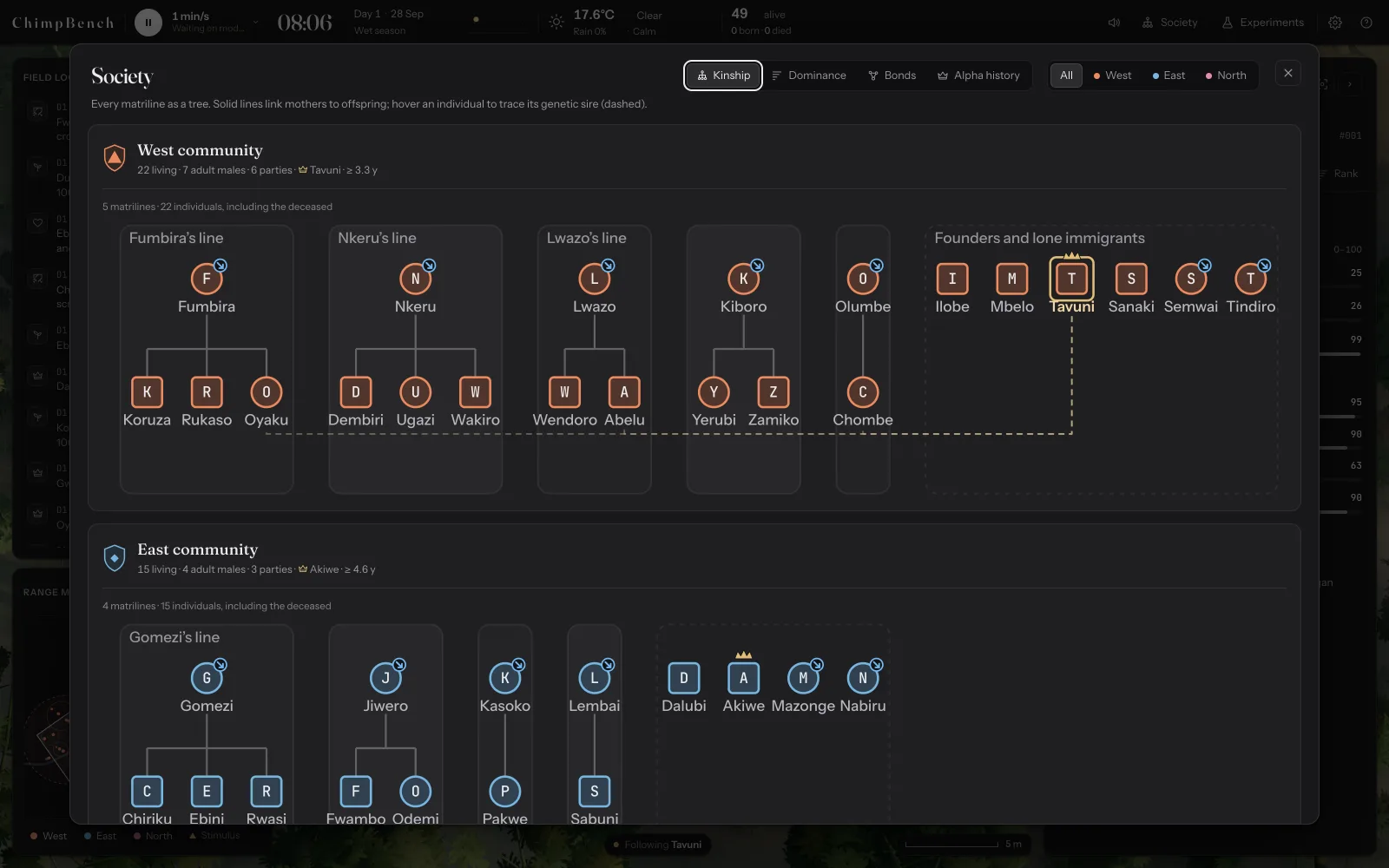
The Society overlay, Kinship view: each West and East matriline drawn as a small tree, such as Fumbira's line with Koruza, Rukaso and Oyaku, plus founders and lone immigrants. A dashed line traces the genetic sire links of the alpha, Tavuni.
Kinship. Every matriline as a tree; dashed lines trace genetic sires.
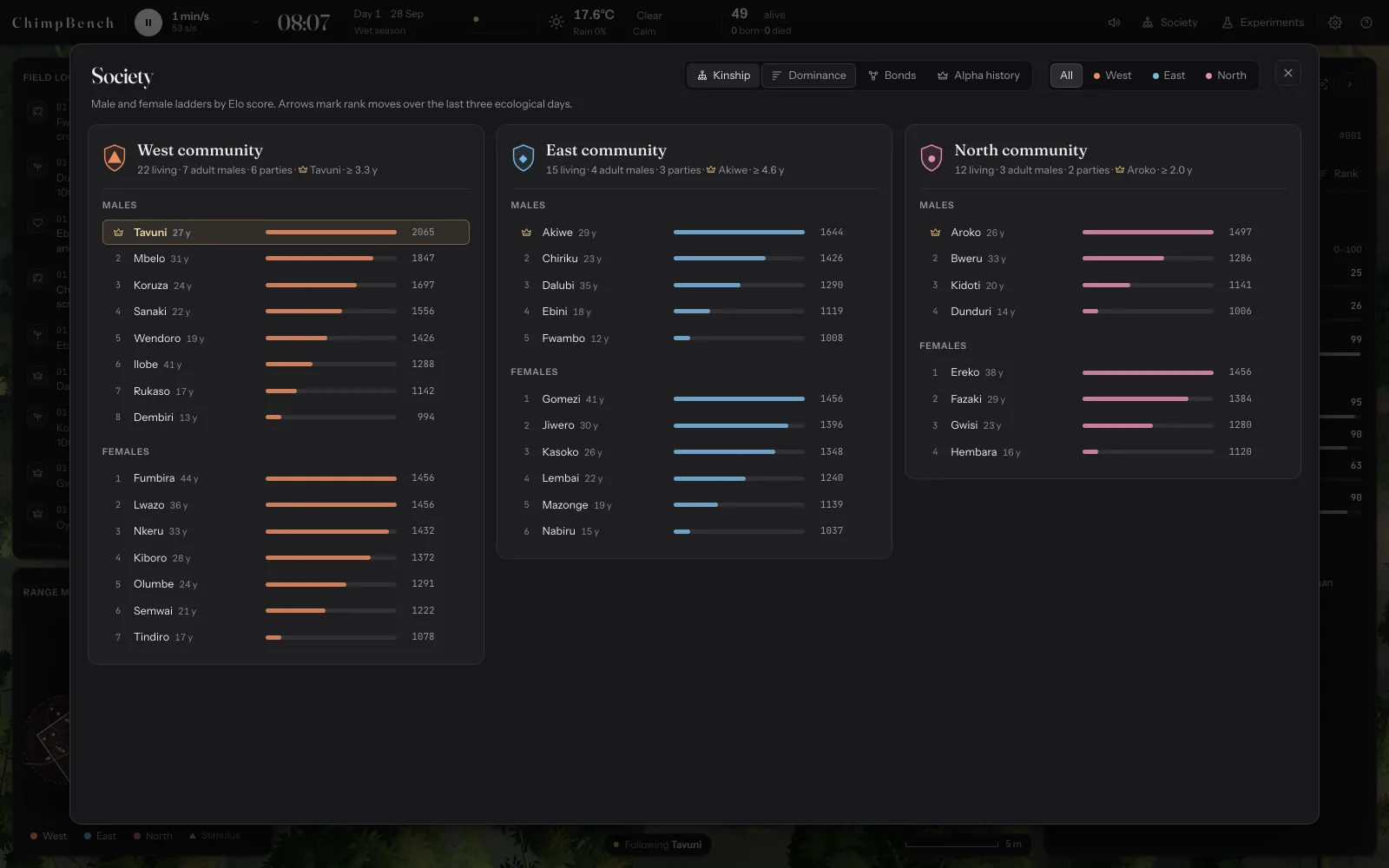
The Society overlay, Dominance view: male and female ladders for West, East and North, each chimp with an Elo score bar; Tavuni tops West's males at 2065, followed by Mbelo, Koruza and Sanaki.
Dominance. Male and female ladders by Elo score, per community. Press T in the app.

Field experiments

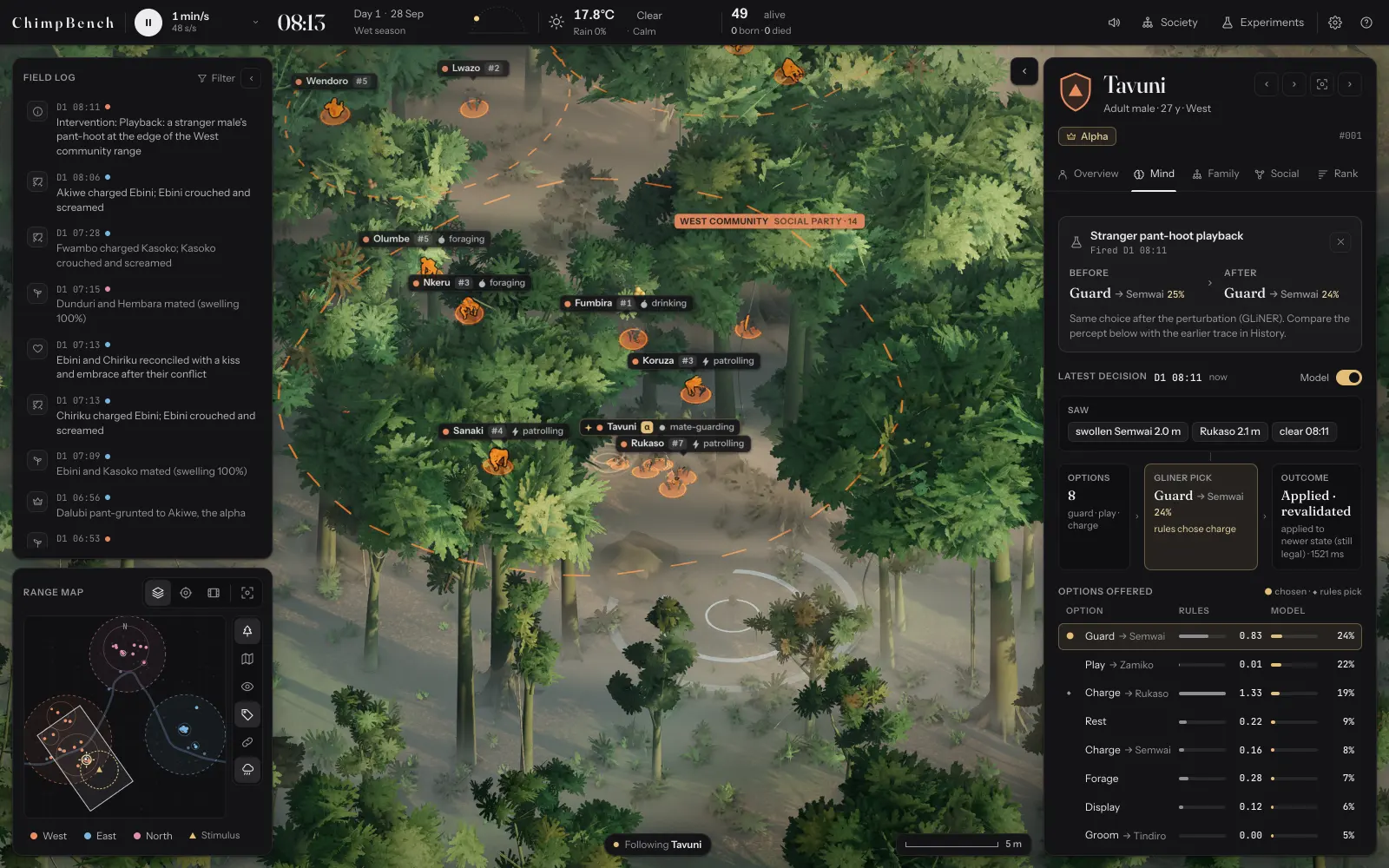
Field experiments test how chimps react when they perceive or experience a specific event, such as a stranger's call played from the edge of their range or a model snake on a trail. In the app, the Experiments panel places the same kinds of events in the simulated forest, and the Mind tab shows a chimp's choice just before and just after.

  • Stranger call playback

    A hidden speaker plays a strange male's pant-hoot. Do they go look, call back or sneak away? (Wilson, Hauser & Wrangham 2001)

  • Snake model

    A fake viper on the trail. Who spots it, and do they warn the ones who haven't? (Crockford et al. 2012)

  • Fig feast

    A giant fig ripens all at once. Watch everyone show up.

  • Storm

    A heavy downpour, right now. Everyone hunkers down; a few males do a rain display.

  • Drought

    A few days with hardly any fruit. Parties shrink and squabbles over food go up.

  • Remove the alpha

    The boss vanishes. Watch the struggle to fill the top spot.

  • Monkeys arrive

    A group of red colobus moves in overhead. Hunting chance. (Watts & Mitani 2002)

  • Before and after

    The Mind tab puts the chimp's choice right before the experiment next to the one right after.

A stranger pant-hoot playback, following Tavuni. On the map, West parties react and Sanaki and Rukaso set off on patrol. The experiment card reads Before: Forage 40%, After: Flee 100%. Below it, the Mind tab's latest decision, with a small Model switch, shows what Tavuni sensed, a stranger male pant-hooting from the south about 18 m away; GLiNER, the app's decision model, picked Flee at 100% and the rules agreed.
Stranger playback, before and after. In this example run, Tavuni was foraging (40% from the app's decision model, GLiNER2.5-Decide). After a stranger's call about 18 m away, the model picks flee at 100% and the rules agree, while Sanaki and Rukaso set off on patrol. Field playbacks found the same pattern: small parties back off, bigger male parties move in (Wilson, Hauser & Wrangham 2001).

Architecture

One rule organizes the code: only the simulation changes the world. The 3D view, the sound and the interface read it; the decision loop asks it for a chimp's view and returns a checked choice.

The engine

  1. Simulation

    Every chimp's body, mind and relationships, plus the forest they live in. The only part that changes the world.

  2. Clock

    Moves the world forward in fixed 15-second steps.

  3. Saves

    Your simulations, stored in your browser. Reload and carry on.

The brains

  1. Decision loop

    Picks which chimps ask the decision model, sends it what that chimp sees, and hands a checked pick back to the simulation.

What you see and hear

  1. 3D forest

    Terrain, trees, sky, rain and every chimp, animated. Read only.

  2. Sound

    Calls, birds, rain and thunder, placed around your camera. Read only.

  3. Interface

    Panels, family trees, rank ladders, experiments and the Mind tab. It sends your controls (speed, experiments) to the simulation.

Made with TypeScript, three.js for the 3D, Web Audio for sound, and SQLite running in the browser for saves.

Chimp data

The field data used to recreate a realistic forest and realistic chimps: open datasets from long-term studies at Ngogo, Gombe and Taï set the forest and its fruit seasons, and give the results the simulated chimps are checked against.

The field data usedNgogoGombeTaï

Eight open datasets from three sites, 1978 to 2024. One builds the simulated forest; the other seven test the simulated chimps.

Loading the datasets…

Each dataset is used under its licence (CC0 or CC BY 4.0) and credited wherever its numbers appear. Raw records never leave data/raw/: this guide shows counts, shares, rates and normalized maps only.

Every target, pass or fail

Each square is one field target. Held-out targets were never used for tuning, and most of the scored ones still fail.

Loading the scorecard…

Targets and pass bands: data/targets.json, from 124 cited studies. Verdicts: the latest year-long field-profile runs of the virtual researcher. A tuned, encoded or compromised target never counts as a pass.

Behaviour by behaviourfield bandeach simulated seedoutside the bandM, F: scored per sex

Grooming time, fruit in the diet and male bonds land in the wild bands on the tuning seeds, less clearly on fresh ones. Being improved: hunting success, patrol rate and home range are well outside their bands.

Loading…

Each row has its own scale, from zero. Bands, sites and sources: data/targets.json; values: the tuning seeds.

Fruit calendar

Ripe fruit is chimps' main food, and its timing affects party size and travel. At Ngogo, researchers recorded ripe fruit on the same marked trees every month from 1998 to 2017 (Potts et al. 2020). The simulated forest (field profile) uses this record directly: its fruit follows the Ngogo months in order, year by year.

Twenty years of ripe fruit at Ngogo

Ripe fruit comes in pulses, and no two years repeat. The simulated forest steps through these years in order, month by month.

Data: Ngogo, Kibale National Park, 1998–2017 (Potts et al. 2020, Biotropica; data Dryad, CC0). The ripe-fruit score is the source's crop-weighted index. Monthly aggregates are derived by ChimpBench; not endorsed by the authors.

Ripe fruit by species and month

The eight Ngogo species in the simulated forest fruit at different times, and the figs carry a little fruit almost all year, which keeps some food available when other species have none.

Loading the species records…

Share of monitored stems with ripe fruit, per species and month (same source, CC0). The ninth species, Ficus sansibarica, isn't on the Ngogo transect and uses the fig average.

Movement

Three open datasets record where wild chimps went: GPS fixes from Ngogo (2011–2023), 30-minute focal records from Taï (2013–2016) and 15-minute focal follows from Gombe (2000–2003). The same measures are computed for real and simulated chimps: home-range area and core area (95% and 50% kernels), how use spreads across the range, 30-minute step length, turning angle and how straight a day's path is. The virtual field observer samples the simulated chimps on the same schedules. Status: the way use spreads within a range matches Ngogo. Being improved: ranges are about three times too small for the group size, and day paths double back too often.

Similar

  • Loading the comparison…

Different

    Not comparable yet

      Range area: the simulated communities' ranges are at least 2.7× smaller than the band for wild communities of about 22 members (1.8 km² against 5–16 km²), while the way use spreads inside a range matches. Day paths: net distance divided by distance walked is …, against … at Taï and … at Gombe, and simulated chimps reverse direction more often. Parties: about 3 chimps, against about 6 at Taï.

      Being improved. These charts come from an earlier run. Later changes brought turning and party size closer to Taï, but not straightness (0.23 against 0.50): each change that raised straightness made turning or party size worse. Movement work is paused until the next full test run, and the charts will be redrawn after it.

      Simulated ranges, to scalesimulatedwildtop of the size-matched band

      Against wild communities of the same size, simulated ranges are several times smaller (being improved). Ngogo is shown for scale only: it has about nine times as many chimps, so it is not a like-for-like comparison.

      Loading…

      Size-matched band: data/targets.json T-RNG-1 (Kanyawara, Budongo Sonso and Waibira; Taï). Taï groups of 11–23 members, yearly 95% kernels (Lemoine et al. 2020, CC BY 4.0). Ngogo community kernel, 2011–2014 (Sandel et al. 2026, CC BY 4.0). Simulated: field profile, 95% kernels, five seeds.

      Why the maps look abstract. Chimp location data can help poachers, so it's handled carefully and this guide never shows where any chimp actually was. Each map is centred on its range, scaled by its own range radius (r), rotated to its long axis and mirrored. Only the shape is left, and shape is what's being compared.

      Six full days: Gombe vs simulatedDifferent

      Measured in range radii, a simulated day covers more than twice the distance of a Gombe day but ends about as far from its start, because it doubles back more often (being improved).

      Loading the paths…

      Six full days per side at evenly spaced straightness ranks, so neither side is cherry-picked. Real: Gombe National Park, Kasekela community, 2000–2003, 30-minute records from 15-minute focal follows (Pusey & Schroepfer-Walker 2013; data Dryad, CC0). Paths are re-drawn from the records after privacy normalization; not endorsed by the authors.

      Distance covered in 30 minutes

      …

      Taï, western chimpanzeesGombe, eastern chimpanzeesSimulateddotted: median
      Turning between 30-minute stepsDifferent

      At both wild sites, most turns between 30-minute steps are small. Simulated chimps make more sharp reversals (being improved).

      Loading…

      Turning angle between consecutive 30-minute steps. Taï: steps of 15 m or more (Lemoine et al. 2023, CC BY 4.0); Gombe: every second 15-minute record (Pusey & Schroepfer-Walker 2013, CC0).

      The Ngogo split

      How much the ranges of Ngogo's two halves overlap, year by year (1 = the same range, 0 = none). The community polarized in 2015 and was two groups by 2018. No simulated community has split yet, so the simulated lines stay flat.

      Ngogo, West vs CentralSimulated: best split inside one communitySimulated: two neighbouring communities
      How the day is spentshare of 30-minute records

      The daily budget is close to Taï's: a bit more feeding, a bit less rest.

      Loading…

      Taï only records rest, travel and feeding, so grooming and other social time count as rest here.

      Scorecard

      Real data. Ngogo, Kibale National Park, Uganda: a GPS subsample from … (Sandel et al. 2026, Zenodo), the supplement to Sandel et al. 2026, Science. Taï National Park, Côte d'Ivoire: western chimpanzees (P. t. verus), not Kibale; 30-minute follow records from … (Lemoine et al. 2023, PLOS Biology) and territory sizes (Lemoine et al. 2020, Royal Society Open Science). All CC BY 4.0. Gombe National Park, Tanzania: 15-minute focal follows of Kasekela adults, 2000–2003 (Pusey & Schroepfer-Walker 2013, Phil Trans R Soc B; data Dryad, CC0), compared at every second record, the 30-minute spacing of the Taï records. The statistics and normalized maps are derived by ChimpBench, not endorsed by the authors.

      Patrols and territory

      A boundary patrol is a group of males walking the edge of their range, stopping to listen and sometimes crossing into a neighbour’s range. Patrol records from Ngogo, Gombe and Taï give how often patrols happen, who joins and how long they last, and the simulated patrols are measured the same way.

      Loading the comparison…

      Patrols by month of the year

      Gombe is the fair seasonal reference: its patrols come from daily follows all year round, and they happen in every month. Ngogo's monthly counts mostly show when observers were in the field.

      Loading the patrol records…

      Each site's patrols by calendar month, averaged over its study years. Gombe 1978–2007 (Massaro et al. 2022; data Dryad, CC0). Ngogo 1996–2015 (Langergraber et al. 2017; data Dryad, CC0). Monthly counts only; no dates or names.

      Patrols by the numbers
      MeasureNgogoGombeBandSimulated
      Loading…

      Numbers computed from open records say open data; the rest are published figures. Each band was fixed before any run of the corrected patrol model. Ngogo's community is far bigger than the simulated ones (24–44 males), so shares and rates are the fair comparison, not head counts.

      Who joins a patrol

      In a small community most males go on most patrols. In Ngogo's huge one, the typical male joins about a third.

      Loading…

      One dot per male, anonymous. Gombe (Massaro et al. 2022, CC0): share of observed patrol opportunities joined over the whole study. Ngogo (Langergraber et al. 2017, CC0): share of the patrols a male was listed on that he joined, males listed on 20 or more.

      Advance or retreat after a border stop

      …

      Taï, western chimpanzeesSimulatedshaded: the band
      Where border stops happen

      …

      Taï border stops

      Before and after the Ngogo split

      Territory gained after killings

      Patrols vs ordinary visits to the edge

      Gombe, 1978–2007: patrols against ordinary visits to the edge of the range, seen on the same daily follows.

      Measures not yet comparable

        Only summaries leave the raw files. The patrol records name individual chimps and give exact dates. This guide publishes counts, shares, rates and distances measured in range radii, never a name, a place or a day.

        Real data. Ngogo, Kibale National Park, Uganda: patrols 1996–2015 (Langergraber et al. 2017, PNAS; data Dryad), patrols after the split, 2016–2024 (Sandel et al. 2026, Science; data Dryad) and tree phenology 1998–2017 (Potts et al. 2020, Biotropica; data Dryad). Gombe National Park, Tanzania: patrols and periphery visits 1978–2007 (Massaro et al. 2022, Phil Trans R Soc B; data Dryad). These four are CC0. Taï National Park, Côte d'Ivoire: border stops 2013–2016, western chimpanzees (P. t. verus), not Kibale (Lemoine et al. 2023, PLOS Biology, S3 Data, CC BY 4.0). Published figures: Mitani & Watts 2005, Amsler 2010, Watts et al. 2006, Mitani, Watts & Amsler 2010 and Watts & Mitani 2001. The statistics are derived by ChimpBench, not endorsed by the authors.

        Credits

        The tools, decision models, sound and field data behind ChimpBench, and the studies it draws on, each with its licence, are listed on the Credits page.